

Last updated
Author
Éva Juhász
Topic
Safety data sheet preparation, translation and updating
Can ChatGPT Write Your Safety Data Sheet? An Honest Answer from a Team That Builds AI
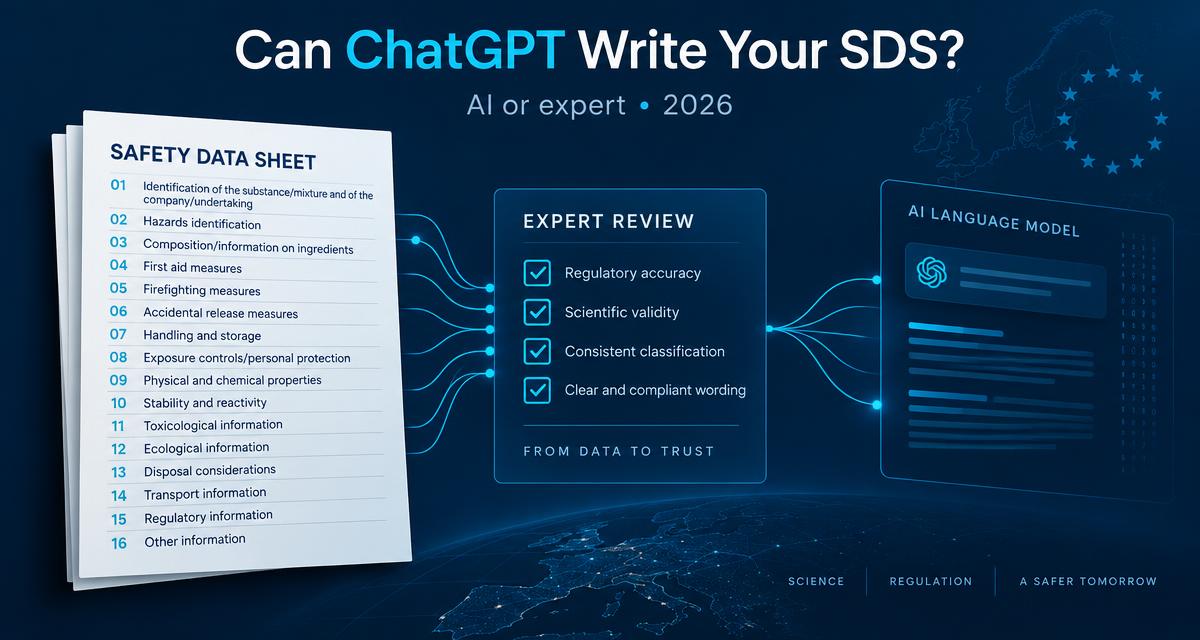
Almost every day, we receive an e-mail written with artificial intelligence, and sometimes a ready-made safety data sheet draft. Increasingly, companies tell us they plan to prepare the document in-house with ChatGPT. The appeal is understandable: the tool produces professional-looking text within minutes.
We are not writing as AI sceptics. We develop our own AI-assisted software, so we see at close range where the technology genuinely saves time and where a professional decision is indispensable.
Can ChatGPT write your safety data sheet?
It can write the text, but it cannot guarantee compliance on its own. A general chatbot can produce a 16-section document within minutes, yet it does not automatically know your complete formulation, the quality of the evidence or every current destination-country requirement.
An SDS is also an emergency instruction manual. It informs warehouse staff dealing with a spill, clinicians treating exposure and firefighters choosing an extinguishing medium. Plausible but incorrect data is therefore more than a drafting problem.
Who may prepare an SDS under EU rules?
Point 0.2.3 of Part A of Annex II to REACH requires the safety data sheet to be prepared by a competent person, while the supplier must ensure appropriate training, including refresher training. The document must be supplied in an official language of the destination Member State and updated without delay when new hazard or risk-management information becomes available.
- Commission Regulation (EU) 2020/878 sets out the current Annex II content requirements.
- Article 31(5) of REACH sets the language requirement.
- Article 31(9) governs updates and communication to affected recipients supplied in the preceding 12 months.
ChatGPT may be a tool, but it cannot be the competent person responsible for the document. Professional and legal responsibility does not pass to the model provider.
Why does the current legal position matter so much?
Commission Delegated Regulation (EU) 2023/707 introduced new CLP hazard classes for endocrine disruption, PBT/vPvB and PMT/vPvM properties. The transitional dates apply from 1 May 2025 for new substances and 1 May 2027 for substances already on the market; for mixtures, the corresponding dates are 1 May 2026 and 1 May 2028. An older or non-EU source SDS therefore cannot simply be rewritten in another language.
Where does general-purpose AI most often fail?
The most dangerous errors tend to be plausible rather than obvious. Seven recurring risks may be concealed by tidy formatting.
Guessed classification
Mixture classification must be derived ingredient by ingredient and concentration by concentration. A general model may provide a plausible estimate instead of a calculation.
Reworded fixed statements
CLP hazard and precautionary statements use official wording. A stylistically smoother version may no longer be the prescribed statement.
Missing national elements
Sections 8, 13 and 15 contain country-specific limits and rules. Translation alone does not localise them.
Outdated rules
Chemicals legislation changes. The model’s cut-off, the source it uses and the law currently in force may differ.
Confident mistakes
An incorrect physical property or invented reference can appear in prose that looks just as polished as correct information.
Trade-secret exposure
The formulation needed for classification is sensitive corporate information. It does not belong in a public chatbot.
Diverging versions
Language versions, the label and the SDS can drift apart without a controlled source of truth.
How common are deficient safety data sheets?
ECHA’s REF-11 enforcement project examined more than 2,500 safety data sheets across 28 countries. The published results state that 35% of the SDSs checked failed to comply with the requirements examined, while 27% showed data-quality deficiencies. This was not a study specifically of AI-generated SDSs; it demonstrates that professional errors were already widespread before generative AI became commonplace.
ECHA’s REF-11 results also report a range of enforcement measures. AI does not necessarily create the underlying problem, but it can make a faulty document faster to produce and more convincing.
Why is machine translation of a foreign SDS not enough?
SDS translation is also regulatory localisation. In addition to fixed CLP wording, destination-country occupational exposure limits, waste and legal references, and emergency information need to be checked.
For a product entering the EU from China, an SDS prepared to a Chinese standard cannot automatically be treated as a document compliant with Annex II to REACH and CLP. In practice, such a non-EU-format SDS must be checked and adapted to EU requirements. Under Article 8 of REACH, a non-EU manufacturer may appoint an Only Representative who assumes the importer’s registration obligations; each supplier in the chain nevertheless retains its own Article 31 duty to provide and keep the SDS updated for its customers.
What is the difference between an AI-written and an AI-assisted SDS?
| Aspect | General chatbot | Manual expert process | InnovaDocs + expert |
|---|---|---|---|
| Classification decision | Risk of model estimation | Expert calculation | Rule system calculates, expert approves |
| H and P statements | May reword them | Manual verification | Controlled source, unchanged |
| National elements | May be missing | Depends on expert diligence | Country-specific data sources |
| Regulatory updates | Uncertain knowledge cut-off | Individual monitoring | Controlled update process |
| Responsibility | The model assumes none | The provider assumes it | Expert review and professional indemnity cover |
| Turnaround | Minutes, without validation | Depends on consultation | 5 working days; express 48 hours |
How do we use AI in InnovaDocs?
AI supports text interpretation and data extraction. We do not leave classification decisions to a language model: the professional rule system calculates, controlled catalogues provide fixed wording, and an expert reviews and approves the document.
- Data extraction: supplier documents and product information become structured input.
- Rule-based calculation: classification follows the applicable CLP rules.
- Controlled wording: fixed statements do not come from free-form machine translation.
- National localisation: country-specific elements are handled for the destination market.
- Human approval: an expert checks consistency and the final result.
The machine provides speed; the human provides professional control. InnovaDocs supports consistent expert work rather than replacing the expert.
What can you safely use AI for in-house?
Useful supporting tasks
- understanding a supplier’s SDS;
- drafting internal training material;
- collecting questions for an expert;
- drafting e-mails and summaries.
Do not leave these to AI alone
- processing a full formulation in a public tool;
- final hazard classification;
- approval of an SDS placed on the market;
- certifying destination-country compliance.
What does an expert-reviewed SDS cost?
We publish our prices openly. Standard turnaround is 5 working days from complete data submission; express service is 48 hours, with two slots available per day.
| Service | Standard | Express |
|---|---|---|
| New safety data sheet | HUF 39,900 per SDS | HUF 49,900 per SDS |
| SDS translation | HUF 39,900 per target language per SDS | HUF 49,900 per target language per SDS |
| Update of an existing SDS | HUF 39,900 per SDS | HUF 49,900 per SDS |
| Clone SDS | HUF 9,900 per SDS | No express lane |
Prices are net and exclude VAT. If an authority raises a question about the professional content of an SDS we prepared, we make the necessary amendment free of charge.
What is the next step?
For a detailed explanation of the production process, read our guide to safety data sheet preparation. If the source information is already available, you can start your order online.
Éva Juhász
Éva Juhász is a chemical engineer and certified chemical safety inspector. She has 13 years of regulatory and public-health management experience, 25 years of professional practice in total, and has contributed to more than 4,500 safety data sheets.
Last updated:
Frequently asked questions
- Will authorities accept a safety data sheet written with ChatGPT?
- Authorities assess whether the content and format comply with Annex II to REACH, rather than which tool was used. The SDS must be prepared by a competent person, and the supplier remains responsible for its content.
- Can I translate my supplier’s SDS with DeepL or ChatGPT?
- It may help you understand the source document, but it is not sufficient for a final document placed on the market. Fixed CLP wording, destination-country exposure limits, emergency details and legal references must also be checked and localised.
- Who is liable if an AI-written safety data sheet is wrong?
- A chatbot cannot assume the supplier’s obligations under REACH. The manufacturer, importer or other relevant supplier in the EU supply chain remains responsible for providing a compliant SDS.
- Can I upload my product formulation to ChatGPT?
- We do not recommend uploading trade secrets or a full formulation to a public AI tool. Use only an organisation-approved environment with suitable data-processing terms.
- Does InnovaTox use artificial intelligence?
- Yes, mainly to support text interpretation and data extraction. Classification is performed by a rule system, controlled wording comes from verified sources, and every SDS is approved by an expert.